Do you suspect fraud against the government?
A free and confidential conversation can give you clarity on your situation and help you decide the right way forward for you.
100% free & confidential
A free and confidential conversation can give you clarity on your situation and help you decide the right way forward for you.
100% free & confidential
It often starts with a gut feeling. An invoice that doesn’t look right. A conversation you overhear. A pattern of behavior that just seems off. You work hard, you believe in doing the right thing, and you see something that makes you question if your employer or a company you work with is playing by the rules — especially when taxpayer money is involved.
When people deliberately defraud the government, they often go to great lengths to hide their actions. But they can’t hide everything. Observant and principled employees, contractors, or even competitors can often spot the irregularities that others miss.
If you find yourself in this situation, you may feel uncertain, isolated, and concerned about what to do next.
How do you know if you have a whistleblower case? The answer to this critical question comes from applying the law designed to empower people in these situations: the False Claims Act. A whistleblower lawyer can explain how it applies in your situation.
The primary legal tool for combating fraud against the federal government is the False Claims Act (FCA). Originally passed during the Civil War to fight fraud by suppliers to the Union Army, the law is sometimes called the Lincoln Law. Its core purpose is to hold individuals and companies accountable for knowingly submitting or causing the submission of false or fraudulent claims for payment to the government.
A powerful component of the FCA is its qui tam provision. The term qui tam is short for a Latin phrase meaning “he who sues on behalf of the king as well as for himself.” This provision allows private citizens with knowledge of fraud to file a lawsuit on behalf of the United States government. In this context, the private citizen is called the “relator.”
If the lawsuit succeeds and the government recovers funds, the relator may recover a portion of that recovery as a reward. This system recognizes the immense courage and personal risk it takes to come forward and provides a powerful incentive for people to expose wrongdoing that might otherwise go undetected.
One of the most important aspects of the False Claims Act is its definition of “knowingly.” You do not need a smoking gun email where a CEO explicitly states, “Let’s defraud the government.”
The FCA establishes a broader standard that includes:
This means that a company can’t simply turn a blind eye to obvious fraudulent billing practices and later claim they didn’t know. If they should have known, a whistleblower lawsuit can hold them liable.
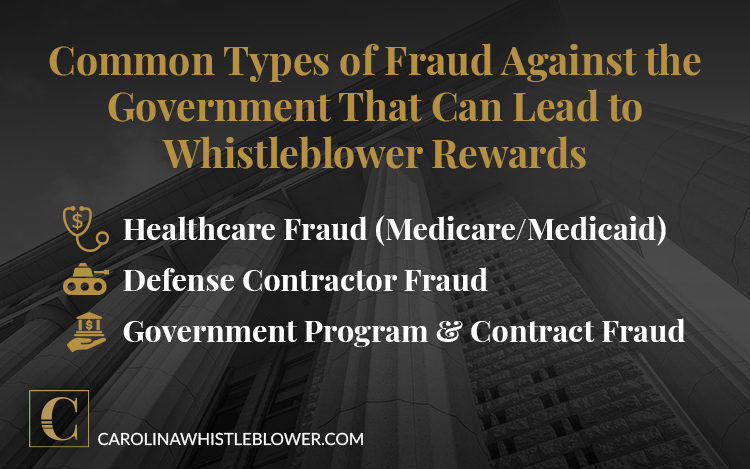
Fraud against the government can occur in any industry that receives federal funding. Despite their complexity, schemes often fall into several common categories. Below are some of the most prevalent types of fraud that can form the basis of a successful whistleblower case.
The healthcare industry is, by far, the largest source of False Claims Act cases. Medicare and Medicaid are vast, multi-billion-dollar programs, making them prime targets for fraud. If you work in healthcare — as a doctor, nurse, hospital administrator, medical biller, or even for a pharmaceutical company — you may witness this fraud firsthand.
Common schemes include:
The U.S. Department of Defense spends hundreds of billions of dollars on contracts for weapons, equipment, and services. This massive scale of spending creates opportunities for fraud.
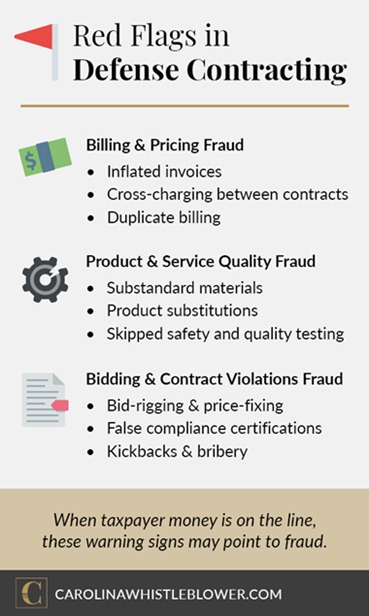 Common military and defense contractor fraud schemes include:
While healthcare and defense are the two largest areas, fraud can occur with nearly any type of government contract or program.
If you have observed any of the activities described above, you may wonder what to do. The law provides a path forward, but it has specific, important rules, such as:
Anyone with original, non-public information about fraud against the government can be a relator. This includes:
You don’t have to be a high-level executive to have a valid case. Often, it’s the people on the front lines who see the fraud most clearly.
A strong whistleblower case requires solid evidence. This can include emails, internal memos, billing records, test results, or detailed witness testimony. However, do not take illegal actions to gather this evidence. An experienced whistleblower attorney can advise you on how to proceed lawfully and help protect your rights.
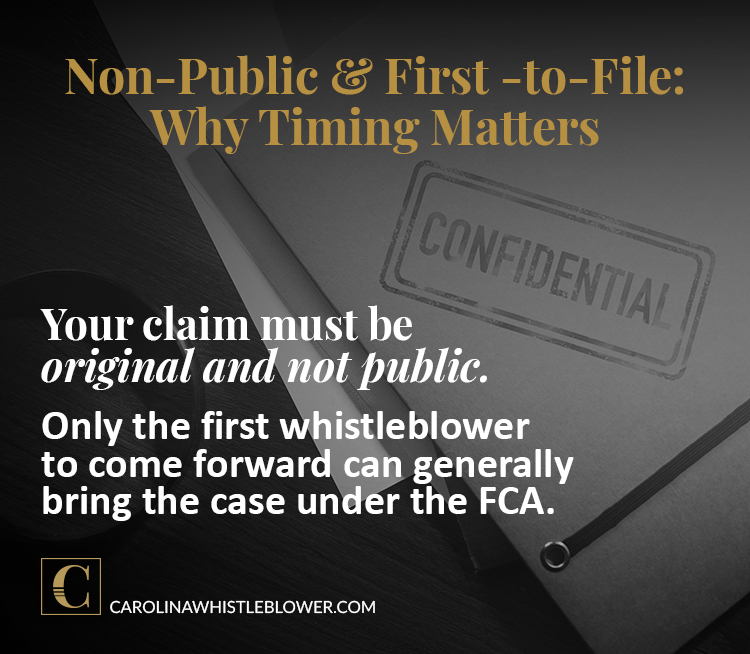 The False Claims Act includes a “first-to-file” rule. This means that only the first relator to file a lawsuit based on a particular set of fraudulent activities can proceed with the case and receive a reward. If someone else files before you do, you may not bring your own case. This rule makes it essential to act promptly — but carefully — once you suspect fraud.
The government understands that blowing the whistle on an employer or a powerful company is an act of courage that comes with significant risk. People are often afraid of losing their jobs, facing professional retaliation, or being ostracized.
Fortunately, the False Claims Act was designed with these fears in mind.
The FCA contains a strong anti-retaliation provision. It is illegal for an employer to fire, demote, harass, threaten, or otherwise discriminate against an employee for taking lawful actions in furtherance of an FCA case. If an employer violates this provision, the whistleblower may be able to seek remedies including:
 As mentioned, the government may reward whistleblowers for their role in stopping fraud. If the case succeeds, the relator may receive between 15% and 30% of the total amount recovered by the government. These rewards can reach millions of dollars.
More importantly, they represent the country’s gratitude to individuals who put themselves on the line to protect American taxpayers and ensure that government funds are used for their intended purpose.
The process of handling a potential False Claims Act case is legally intricate, the stakes are high, and the defendants are often powerful corporations with deep legal resources. You want an advocate who understands the law and has the experience and resources to stand with you every step of the way.
At Carolina Whistleblower Attorneys, we are dedicated to guiding and protecting courageous individuals who come forward to fight fraud.
Our team is led by a former U.S. Attorney, Bill Nettles, who once prosecuted these very types of cases on behalf of the government and helped lead the nation in whistleblower recoveries.1,4 This inside perspective gives us valuable insight into what it takes to build a strong case for the government.
Carolina Whistleblower Attorneys has represented dozens of whistleblowers, with tens of millions of dollars in total settlements since 2016.1 Lead attorney Bill Nettles was responsible for helping the government recover over $307 million in fraudulently-obtained funds during his tenure leading the U.S. Attorney’s Office for South Carolina.1,4
If you have knowledge of fraud against the government, you have the power to try to do something about it. Contact Carolina Whistleblower Attorneys at 1-888-292-8852 or through our online form for a free, 100% confidential case evaluation and conversation. Our experienced team can explain your rights and options. And if you choose to partner with us, you pay no fee unless we obtain a financial recovery for you. Guaranteed.2
Let’s fight together to stamp out corporate greed.
“Bill has the ability to ‘think outside the box’…which makes him extremely effective as an advocate for his clients.” 1 — Attorney who previously worked with Bill





If you’re wondering if it’s a good idea to speak with a whistleblower lawyer about what you know, let us set the record straight.
"*" indicates required fields


