Do you suspect nursing home fraud?
Help protect our elderly population in nursing homes from Medicare, Medicaid, & TRICARE fraud that steals money from those that need it most.
I suspect nursing home fraud – Let’s chat
100% free & confidential
Help protect our elderly population in nursing homes from Medicare, Medicaid, & TRICARE fraud that steals money from those that need it most.
I suspect nursing home fraud – Let’s chat
They are our parents, our grandparents, our neighbors. Many elderly and vulnerable members of our communities rely on nursing homes to provide compassionate, essential care. Yet, this trust is broken far too often. Some for-profit nursing home corporations prioritize profits over patients, systematically defrauding government healthcare programs like Medicare, Medicaid, and TRICARE.
This isn’t just a betrayal of our most vulnerable; it’s theft from every American taxpayer.
If you suspect fraud at a nursing home, you may be in a position to stop it. At Carolina Whistleblower Attorneys, we want you to know that you are not alone, you have powerful rights, and we want to help you.
The North and South Carolina nursing home fraud whistleblower attorneys at Carolina Whistleblower Attorneys are here to listen, to advise you of your options, and, if you choose to move forward, to fight for you.
You have the power to try to hold greedy corporations accountable. For a free and 100% confidential consultation, contact our experienced team today.
Your case demands a dedicated team with proven experience and the power to challenge large corporations.
Here’s what Carolina Whistleblower Attorneys can offer you:
We are dedicated to protecting your interests and fighting for what is right.
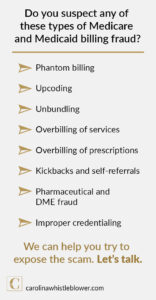 Government agencies that oversee healthcare are often understaffed and overwhelmed, and sometimes must rely on courageous individuals with inside knowledge to expose wrongdoing. Nursing home fraud can be subtle and complex, often hidden within billing codes and patient charts. As an employee or even a competitor — whether you are a nurse, therapist, administrator, or billing specialist — you may be in position to recognize it.
Here are some of the most common types of fraud perpetrated by nursing homes against Medicare, Medicaid, and TRICARE, which are violations of the federal False Claims Act.
This is one of the most widespread forms of nursing home fraud. It occurs when a facility provides and bills Medicare or Medicaid for services that are not required for a patient’s condition. Some for-profit chains may implement corporate-wide policies that push for maximum therapy for every patient, regardless of their actual medical needs or even the patient’s ability to tolerate the services.
“Upcoding” is the practice of knowingly using a billing code that indicates a patient is sicker or requires more complex care than they actually do. To justify these higher billing codes, staff may be instructed to falsify information in Patient Assessment Instruments (PAIs) or Minimum Data Set (MDS) forms, exaggerating a resident’s needs.
This is an outright form of theft. A nursing home may bill the government for services that were never performed or for care provided to patients who have been discharged or are deceased. This can also include billing for medical equipment or supplies that were never given to the resident.
The “worthless services” standard under the False Claims Act is a high bar, but it applies in egregious cases of neglect. If a nursing home’s care is so substandard that it is essentially non-existent or of no medical value, billing the government for that “care” can be considered fraud. This often goes hand-in-hand with severe understaffing.
The Anti-Kickback Statute makes it illegal to offer, pay, or receive anything of value to induce referrals for services paid for by federal healthcare programs. The Stark Law prohibits physicians from referring patients to entities with which they have a financial relationship.
Other common examples of nursing home fraud include:
If you have seen any of these activities or suspect wrongdoing, you may have the foundation for a whistleblower case. Your knowledge could be the key to stopping the theft of millions of taxpayer dollars.
Many of the whistleblowers we help were people put in a terrible position. A manager may have instructed them to upcode a patient’s chart or bill for a service they knew wasn’t necessary. They may have complied out of fear for their job.
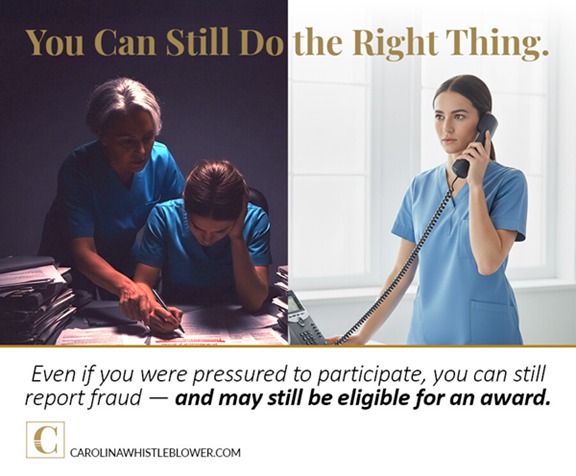 It’s important to know that you can still be a whistleblower even if you participated in the fraud. In fact, coming forward may be the best way to protect yourself and do the right thing. The government understands the pressure employees face and an experienced whistleblower attorney may be able to get the government to look more favorably upon those who have the courage to expose the scheme.
Let’s talk about your specific situation. Contact us for a confidential and free discussion about your options.
When you witness fraud against the government, you aren’t powerless. A Civil War-era law, nicknamed the “Lincoln Law,” gives you a path to take action. The False Claims Act (FCA) is one of the government’s most powerful tools for fighting fraud, and it allows private citizens to file lawsuits on the government’s behalf.
These lawsuits are called qui tam actions (from a Latin phrase meaning “he who sues on behalf of the king as well as for himself”). The person who comes forward with the information is known as the “relator.”
The FCA serves two critical purposes for whistleblowers: it offers powerful protections and significant potential financial rewards.
The government recognizes that blowing the whistle takes immense courage and involves personal and professional risk. To incentivize people to come forward, the FCA allows successful relators to potentially receive a share of the money the government recovers.
A successful whistleblower is potentially entitled to a reward of up to 30% of the total amount recovered by the government.
These recoveries can be substantial. Nursing home fraud cases often involve millions or even tens of millions of dollars. Our attorneys have helped whistleblowers receive life-changing rewards for their bravery, but importantly, they also helped stop companies from continuing to steal from taxpayers.1
Fear of losing your job is one reason people may hesitate to report fraud. The False Claims Act contains a strong anti-retaliation provision to protect you.
Your employer is legally prohibited from retaliating against you for lawful acts done in furtherance of an FCA action. This includes:
If an employer violates this provision, you may be entitled to relief, including reinstatement to your job, double your back pay, and other damages. At Carolina Whistleblower Attorneys, we know how to use the full force of the law to try to protect you.
Whistleblowers have been instrumental in recovering billions of dollars from fraudulent nursing home chains. These settlements send a powerful message to the industry and resulted in significant rewards for the relators who brought the information forward.
These are just a few examples. Your information could lead to the next major victory against fraud.
From 2013 to 2017, Saber Healthcare Group reportedly required directors and therapists at their nursing home facilities in North Carolina and other states to commit systemic fraud.
Saber allegedly told their employees to place all newly admitted residents into the “ultra-high” category (the category that brought the most Medicare reimbursement for nursing homes). This was directly contrary to Medicare regulations that cover only what is “reasonable and necessary for the diagnosis or treatment of illness or injury.”
The Saber whistleblowers, or the “relators,” claimed that even if the residents did not need or could not tolerate therapy at that level, they were still instructed by the facility to categorize residents at that level. Moreover, some of the therapy services they provided were unrelated to that individual’s medical needs. Saber settled for $10 million. The three whistleblowers who alerted the U.S. government to the wrongdoings were awarded $1.75 million of that settlement.3
Fraudulent billings to the government occur far too often in South Carolina, too. In one case, an owner of six nursing homes defrauded state Medicaid for more than $1 million in overpayment over two years.3
Those were taxpayer dollars, dollars that should go to provide real nursing home care to seniors who can’t otherwise afford it.
Here are answers to frequently asked questions about nursing home fraud whistleblower cases:
How much does it cost to hire an attorney?
Nothing to get started right away. Carolina Whistleblower Attorneys operates on a contingency fee basis which means we only collect a fee if we are successful in helping you get a reward in a successful case. You will never have to pay upfront for our services.2
Will my employer find out I am the whistleblower?
When a qui tam lawsuit is filed, it is filed “under seal.” This means it is kept secret from the public and, most importantly, from your employer. The case remains under seal for at least 60 days (and often much longer) while the government investigates your claim. This gives you and the government a head start and provides a crucial layer of protection. We prioritize your confidentiality throughout the entire process.
Is there a time limit to file a whistleblower claim?
Yes. The False Claims Act has a statute of limitations, which means you must file your claim within a certain period after the fraud occurred. The rules can be complex, but generally, you must file within six years of the fraudulent act. It is critical to contact an attorney as soon as possible to try to ensure you do not miss your window of opportunity.
What kind of evidence do I need to have a case?
Evidence can include emails, internal memos, billing records, patient charts, text messages, and more. If you suspect fraud, you don’t need to have a “perfect” case to contact us. Even if you only have a strong suspicion, we encourage you to call. Our experienced team can help you determine if you have a viable claim.

You have seen or suspect something that isn’t right. Taxpayer money intended for the care of the elderly is being stolen for corporate profit. Now, you have a critical choice to make.
You can do nothing, and the fraud will likely continue. Or you can take a brave step and explore your options for stopping it.
At Carolina Whistleblower Attorneys, we are ready to stand with you. We have the experience, the resources, and the unwavering commitment to fight for what’s right. Our experienced advocates will make you the priority every step of the way. Contact Carolina Whistleblower Attorneys now at 1-888-292-8852 or through our online form for a confidential conversation with no obligation. Let’s talk through your concerns and help you understand the great power you may have under the False Claims Act.
“Bill has the ability to ‘think outside the box’…which makes him extremely effective as an advocate for his clients.” 1 — Attorney who previously worked with Bill



If you’re wondering if it’s a good idea to speak with a whistleblower lawyer about what you know, let us set the record straight.
"*" indicates required fields