When a company or individual defrauds the U.S. government, they are stealing from every American taxpayer. The funds intended for vital services — from healthcare for the elderly to equipment for our military — are diverted by greed. For over 150 years, our country has relied on a powerful alliance between the government and courageous citizens to fight back. This alliance is built on a landmark law and a powerful potential incentive: whistleblower rewards.
Many people think of a whistleblower reward as just a financial sum. But it is much more. A potential reward is the government’s recognition of your courage and your critical role in upholding justice in a successful case. It acknowledges the personal and professional risks you may have faced by speaking up. And it provides a tangible way to possibly compensate you for helping to recover money that was stolen from the public.
If you suspect fraud against the government, you may be in a position to do something truly significant. Understanding how you might be rewarded for this patriotic act is a crucial first step.
Key Takeaways
- The federal False Claims Act (FCA) is a powerful legal tool for potentially rewarding whistleblowers who report fraud against the U.S. government.
- A private citizen who files an FCA case on behalf of the government is known as a “relator.”
- A relator’s reward in a successful case is generally a percentage of the total funds recovered by the government, typically ranging from 15% to 30%.
- The specific percentage can depend on whether the government intervenes in the case and the relator’s level of contribution.
- Whistleblower recoveries can be magnified by provisions for treble (3x) damages and significant per-claim civil penalties.
- The FCA also includes comprehensive provisions to help protect whistleblowers from employer retaliation.
The legal foundation for whistleblower rewards: The False Claims Act
To understand the potential reward, it’s important to understand the law that makes it possible. The federal False Claims Act (FCA) is the U.S. government’s most important tool for fighting fraud. Originally passed during the Civil War to combat fraud by contractors selling faulty supplies to the Union Army, it is often called the “Lincoln Law.”
The FCA’s power lies in its unique qui tam provision. Qui tam is a legal term derived from a Latin phrase meaning “he who sues on behalf of the king as well as for himself.”
What does this mean for you? It means that a private citizen with knowledge of fraud against the government can file a lawsuit on the government’s behalf. In the context of an FCA case, this private citizen is known as the “relator.”
When you file a qui tam complaint, you are not just reporting fraud — you are initiating a legal process that can hold the wrongdoer accountable. The case is filed “under seal,” meaning it is kept secret from the public and the defendant. This gives the Department of Justice (DOJ) time to investigate your allegations without tipping off the company that you have reported.
If the government’s investigation confirms the fraud and leads to a successful recovery of funds, you, the relator, are generally eligible for a share of that recovery. This share is the whistleblower reward.
How is a whistleblower reward calculated?
The potential reward in a False Claims Act case is not a flat fee. It is generally a percentage of the total amount the government recovers from the fraudulent entity. The specific percentage you may receive depends in part on one critical factor: whether the government decides to “intervene” in your case.
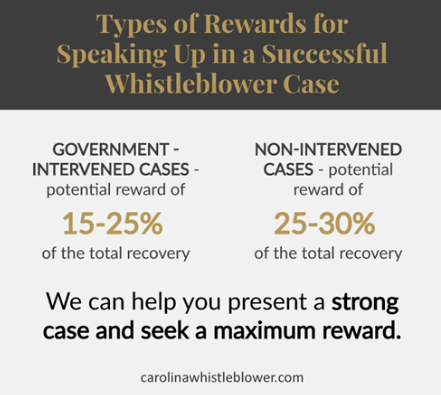
Government-intervened cases: A possible reward of 15% to 25%
After you file your qui tam lawsuit under seal, the government conducts its own investigation. If the DOJ finds your claims to be strong and decides to take over the primary prosecution of the case, this is called intervention.
When the government intervenes, it brings its immense resources to bear, significantly increasing the likelihood of a successful outcome. In successful cases, the relator is generally eligible for a reward of 15% to 25% of the total recovery.
Where you may fall within that 15-25% reward range for a successful intervened case is not arbitrary. The DOJ may consider several factors when determining the final percentage, including:
- The significance of the information you provided: Was your information the key that unlocked the entire case, or did it supplement an existing investigation?
- Your contribution to the investigation: Did you provide extensive, well-organized evidence? Did you wear a wire, provide inside documents, or offer ongoing assistance and testimony?
- The promptness of your report: Did you report the fraud as soon as you discovered it, or did you wait?
- Whether you were involved in the fraud: If you participated in the fraud, this can reduce your potential share. However, reporting the fraud can often be the best way to mitigate your own potential liability. (We’ve helped many whistleblowers facing criminal exposure receive a whistleblower reward instead of jail time!¹,⁴)
A relator who provides critical, detailed, and early information and cooperates fully with the government has a stronger argument for a reward closer to the 25% maximum.
Non-intervened cases: A potential reward of 25% to 30%
Sometimes, the government may decide not to intervene in a qui tam case. This is called a declination. This does not necessarily mean your case has no merit. The government has limited resources and may decline for various reasons, such as workload, the dollar amount of the fraud, or other strategic priorities.
When the government declines, the False Claims Act gives you and your attorneys the option to pursue the case on your own, still acting on the government’s behalf. Because you and your legal team are now shouldering the full risk and expense of litigation, the potential reward is higher.
In a successful non-intervened case, the relator is generally eligible for a reward of 25% to 30% of the recovery.
This higher possible percentage reflects the greater cost and effort required to win a case without the government’s direct involvement. These cases are complex and require a legal team that knows whistleblower law well.
The multiplier effect: Why rewards can be so significant
Under the False Claims Act, the government is entitled to recover far more than the initial amount that was stolen.
This is due to two powerful provisions:
- Treble Damages: The False Claims Act allows the government to recover up to three times the amount of money it lost due to the fraud. This is known as “treble damages.”
- Civil Penalties: In addition to treble damages, the law mandates a per-claim penalty in judgements for each false claim submitted. This penalty amount is adjusted for inflation and can be thousands of dollars per false invoice or claim. A scheme involving hundreds of false billings can result in enormous penalties, on top of the treble damages.
Let’s look at a hypothetical example:
Imagine a medical lab that routinely “upcodes” its bills to Medicare, charging for more expensive tests than were actually performed. Over three years, they overbilled the government by $5 million.
A whistleblower with internal knowledge files a qui tam case. The government intervenes and successfully proves the fraud. Here’s how the recovery might be calculated in this example:
- Actual Damages: $5 million
- Treble Damages (3x): $15 million
- Civil Penalties: Let’s say the lab submitted 1,000 false claims. At a penalty of (for example) $15,000 per claim, that’s another $15 million.
- Total Government Recovery: $15 million + $15 million = $30 million
The whistleblower reward in this example of a successful case is calculated based on the $30 million total recovery, not the original $5 million in fraud.
- Potential Whistleblower Reward (at 20%): 0.20 x 30,000,000 = $6 million
As you can see, the combination of treble damages and per-claim penalties can transform a significant fraud case into a staggering recovery, with a correspondingly significant reward for the whistleblower who brought it to light. And if there’s a judgment (i.e., trial) rather than a settlement, per-claim penalties are mandatory.
What kinds of fraud lead to whistleblower rewards?
False Claims Act cases can arise from any situation where federal government funds are involved. While the schemes are varied, they often fall into a few key categories.
Healthcare fraud (Medicare and Medicaid)
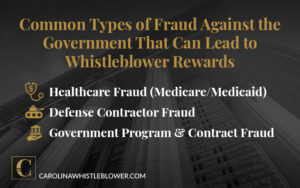
This is the largest area of FCA recoveries. With billions of dollars flowing through Medicare, Medicaid, and other government health programs, the opportunities for fraud are vast. Common schemes include:
- Billing for services not rendered: Charging the government for appointments, procedures, or tests that never happened
- Upcoding and unbundling: Using incorrect billing codes to charge for a more expensive service than the one provided (upcoding) or billing separately for services that should be bundled into a single, lower-cost code (unbundling)
- Providing medically unnecessary services: Performing tests, procedures, or prescribing medications that are not needed for a patient’s condition simply to generate government reimbursements
- Kickbacks and self-referrals: Violations of the Anti-Kickback Statute (paying for patient referrals) or the Stark Law (doctors referring patients to facilities in which they have a financial interest)
- Pharmaceutical and medical device fraud: This includes schemes like providing illegal kickbacks to doctors for prescribing certain medications or devices
Defense contractor fraud
The original target of the FCA remains a major source of cases. This can involve any company with a contract to provide goods or services to the Department of Defense or other military and national security agencies. Examples include:
- Billing for substandard parts: Knowingly providing equipment, materials, or technology that does not meet contract specifications
- Cross-charging: Billing costs from a fixed-price private contract to a more flexible government contract
- Mischarging labor: Billing the government for labor hours that were not actually worked on the specified project
- Violating contract terms: Failing to perform required testing or quality assurance measures while falsely certifying that they were completed
Other government program and contract fraud
Fraud can occur in any area where the government spends money, including:
- Educational and research grant fraud
- Government-backed loan fraud (e.g., PPP loan fraud)
- Infrastructure and transportation contract fraud
- Tariff fraud
More than a reward: The importance of anti-retaliation protections
The financial reward is a powerful incentive, but the False Claims Act also recognizes that potential whistleblowers need protection from retaliation. Many are employees of the companies they are reporting and are afraid of losing their jobs, being demoted, or facing harassment.
For this reason, the FCA contains robust anti-retaliation provisions. These provisions make it illegal for an employer to fire, demote, suspend, threaten, harass, or in any other way retaliate against an employee for taking lawful actions in furtherance of an FCA case.
If an employer violates this protection, the whistleblower can file a separate claim for relief, which can include:
- Reinstatement to their job with the same seniority
- Two times the amount of back pay owed
- Compensation for any special damages (such as emotional distress)
- Payment of their attorneys’ fees and litigation costs
These protections are designed to help you come forward with more confidence, knowing that the law offers a path for recourse against retaliation.
Take the first step with a trusted Carolina Whistleblower Attorney
The decision to blow the whistle on fraud against the government is one of the most courageous and impactful choices a person can make. It is a path that protects taxpayers, promotes true accountability, and helps uphold the integrity of our public programs. The potential for a significant financial reward is the government’s way of thanking you for your patriotism and service in a successful case.
However, the process is legally complex and the stakes are high. Navigating a qui tam lawsuit under the False Claims Act requires deep knowledge, strategic guidance, and your dedication.
But you don’t have to face things alone. At Carolina Whistleblower Attorneys, our team is dedicated to guiding potential whistleblowers through this complex process.
We’ve represented dozens of qui tam whistleblowers, with tens of millions of dollars in total settlements.¹ Our lead attorney, Bill Nettles, is responsible for helping the government recover over $307 million in fraudulently-obtained funds during his tenure leading the U.S. Attorney’s Office.¹,⁴
In a free and completely confidential case evaluation, a Carolina Whistleblower Attorney can review the facts of your situation and discuss your options. This can help you understand your rights and the protections available under the False Claims Act.
If you suspect fraud against the government, you have the power to do something about it. Contact Carolina Whistleblower Attorneys at 1-888-292-8852 or through our online form for a free, 100% confidential case evaluation. Our experienced team can help you understand your rights and protections under the False Claims Act.
Awards we’ve won





For standards of inclusion for awards listed, visit bestlawyers.com, thenationaltriallawyers.org, superlawyers.com, farrin.com/business-nc-power-list, and millondollaradvocates.com. National Trial Lawyers Top 100 designation is for 2025. Regarding the Million Dollar Advocates Forum, we do not represent that similar results will be achieved in your case. Each case is different and must be evaluated separately. Firm award is for the Law Offices of James Scott Farrin. Attorney awards are for attorneys with the Law Offices of James Scott Farrin.

Contact the Carolina
Whistleblower Attorneys
If you’re wondering if it’s a good idea to speak with a whistleblower lawyer about what you know, let us set the record straight.
- Corporate ethics hotlines can be risky and may lead to termination. If you’ve already done this, call us immediately.
- Your coworkers could be aware of the fraud – or complicit in it – and you should not talk to them about it.
- The first claim to be filed under the False Claims Act can proceed – if you’re not first, you’re at a serious disadvantage and may get nothing (another reason not to speak to your coworkers about it).
- A confidential discussion costs you a few minutes, but could save you time, stress, and money.
"*" indicates required fields