Do you suspect fraud against the government in South Carolina or beyond?
Here’s what whistleblowers in the Palmetto State need to know about qui tam lawsuits that help stop fraud against the government.
100% free & confidential
Here’s what whistleblowers in the Palmetto State need to know about qui tam lawsuits that help stop fraud against the government.
Qui tam lawsuits are a tool for South Carolina whistleblowers to expose fraud against the government – and possibly get rewarded for it. These lawsuits are generally brought through the False Claims Act (FCA), which is a federal law. However, there are some South Carolina nuances state residents should be aware of.
Under the FCA, a whistleblower (called a “relator”) can come forward on behalf of the taxpaying public to expose fraud and help stamp out corporate greed. Simply put, if a company knowingly lies to the government to obtain or avoid payment, they may be guilty of violating the False Claims Act.
Since the government has limited access and resources, much fraud against the government would go undetected without the patriotic service of whistleblowers. For their courage in coming forward, a whistleblower can receive up to 30% of the government’s recovery from the fraudster.
Who can be a whistleblower? Whatever your job or industry, if you suspect fraud against the government, you may have a whistleblower claim.
While there is no main South Carolina whistleblower act, South Carolina residents are protected under federal statutes. In addition, South Carolina courts recognize a public policy exception to at-will employment. While at-will employment usually means an employer can fire an employee for any reason they want, this is not the case in whistleblower claims. It is against the public’s interests to allow an employer to silence a possible whistleblower by retaliating and terminating them.
Types of fraud against the government commonly exposed by South Carolina whistleblowers include:
Is someone stealing from the government? Contact us at 1-888-292-8852 for a free and confidential evaluation.
The process for FCA whistleblower protection in South Carolina generally includes three basic steps.
You may be unsure if you have a claim. You may be confident you have a claim, but you’re not sure what proof to gather. You may have proof already in hand but you’re worried about retaliation from your employer.
The first step is for us to talk confidentially. We will only take your case if we believe it will put you in a better financial position. And we can explain all the tools we have under the law to protect you from retaliation.
You want the government to pursue your claim because it means it’s more likely to be successful. But the government can only pursue a limited number of claims.
Our whistleblower team is led by former U.S. Attorney Bill Nettles, appointed by the White House to help bring fraudsters to justice. During his tenure, Bill brought the state of South Carolina to top four in the country for whistleblower recoveries.1 Now, he draws on that immense experience to present our clients’ cases to the government. As his record shows, Bill knows what makes a good case.1
From this point, your claim may go a few different ways. If the government elects not to pursue your case, we may decide to not move forward. Alternatively, we may still choose to pursue it without the government’s involvement. It’s still their case and their money, but your reward may be bigger because your involvement is bigger. We will decide what to do together based on what’s right for you.
Whether the government takes your case or we choose to pursue it privately, we’ll continue to advise you at every step. Our mission either way is to protect you from any form of employer retaliation. And if your claim does not result in a reward, you don’t owe us a fee.2
Learn More: Why should I be a whistleblower?
Anything you discuss with your attorney is completely confidential. If we decide that filing a qui tam complaint is in your best interest, the complaint will be “under seal” for at least 60 days. Something “under seal” may not be shared or discussed by anyone except the parties investigating the case.
Eventually, your identity may become public. But that does not mean you can be retaliated against. There are many anti-retaliation protections available for whistleblowers.
Under the FCA, your employer may not retaliate against your whistleblowing with adverse actions such as:
These are just common examples. Your employer may not punish you in any way for exercising your rights as a whistleblower.
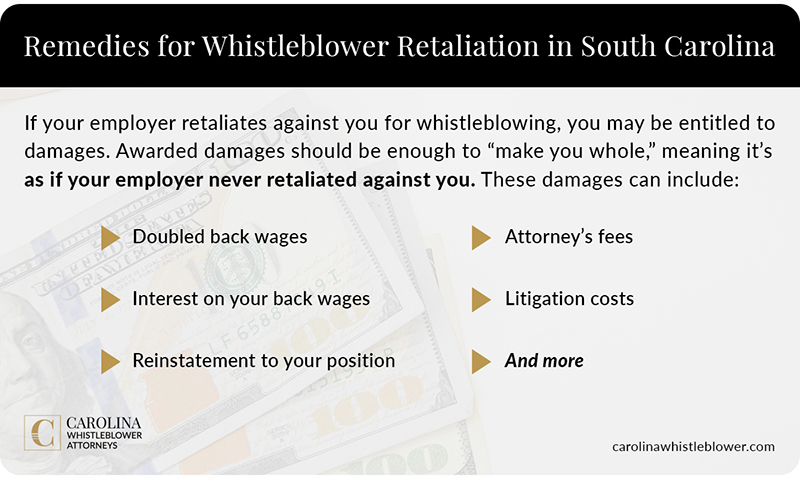
By putting you first. As part of our commitment to you, our skilled and experienced team can help you:
You want an attorney that handles whistleblower cases every day. Our team has decades of combined experience helping good people fight the good fight. In one notable FCA case, we worked with our two whistleblower clients to help the government recover over $22 million from a group of South Carolina urgent care providers who were improperly billing the government.1
The first whistleblower is in the best position to collect a possible reward, so don’t delay. Contact us at 1-888-292-8852 for a free and confidential case evaluation. Someone is available to discuss your concerns at any time.
“Bill has the ability to ‘think outside the box’…which makes him extremely effective as an advocate for his clients.” 1 — Attorney who previously worked with Bill






If you’re wondering if it’s a good idea to speak with a whistleblower lawyer about what you know, let us set the record straight.
"*" indicates required fields